
In reference to the economy, "liberal" means free from the meddling hands of democratically-elected representatives. The idea is basically that capitalists, those unsung stewards of the public good (known, of course, for their unwavering benevolence toward humanity and the natural environment), are free to do whatever the hell they want and that we're all better off for it.

So if a company proves to be highly profitable, those who own the means of production can use these (often untaxed) profits to increase worker wages, reopen American factories, or sell their goods and services at a lower rate in order to ease the economic strain on consumers. Or they could buy a third yacht, this one with its own helicopter landing pad. Since we pretty much just let them write their own laws anyway, it's really up to the "job creators" to decide what they want to do with all that extra money... which didn't materialize out of thin air, by the way. It came from you, the employee and consumer.

This ideology also makes a very deliberate and concerted effort to equate wealth with virtue, as it is premised on the assumption that the richest among us will always do what is best for everyone else. Trickle-down economics isn't just some rich dude pissing on skid row from a penthouse apartment, though it does bear a number of similarities.
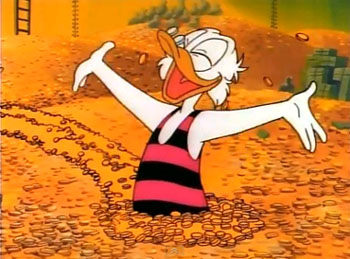
Adding insult to injury, this belief system also demonizes the poor (or the already pissed upon, metaphorically speaking) by implying that the inverse is true as well. The common refrain is that poor people are so as punishment for their bad choices, while a select few among us were born into a life of obscene privilege, blessed with more wealth than they could ever possibly spend in one lifetime. Why? Because they are better than us. Just ask them.
 |
| It's not like we get the good states, either. |
This, in effect, maintains hereditary aristocracies -- you know, like the one from which we declared our independence so many years ago -- all while normalizing their position of privilege as though it is their birthright. This is what neoliberalism has done for you. It is an economic system designed to promote the interests of the already absurdly rich in their endless pursuit of more wealth. Neofeudalism might actually be a more appropriate term.

In order to unpack this idea of neoliberalism, though, we should first figure out how we got here, and that means starting with what is sometimes referred to as "classical liberalism." For this, we will need to go back in time. Since I am fresh out of plutonium and my flux capacitor is on the fritz anyway, we're going to have to just use our imaginations. Set your wayback machines for the year 1776, then follow me.

As a frightening number of Americans would likely tell you, this was the first year that we ever had a fourth of July. Prior to this, they just went straight from July 3 to July 5, but then boom: fireworks.

Obviously, there was a bit more to it than that. In fact, a pretty important document was also written that same year. I'm referring, of course, to the book that is now more commonly referred to simply as Wealth of Nations, by Scottish economist Adam Smith. It was first published in 1776 and quickly became a bestseller worldwide. Hollywood has yet to make it into a movie.
 |
| "Let's just call it Death Dollar." |
If his forgettable name or the boring title of his book don't sound familiar to you, perhaps you've at least heard the term "the invisible hand of the market" before. That's his baby. Smith is the guy behind lassez-faire economics: the idea that capitalism regulates itself naturally through consumer choice... plus a collection of other fairy tales. As a staunch proponent of what is now referred to as 'classical liberalism,' he also theorized that an economy functions best with the least amount of government intervention.
 |
| Basically, Ted Nugent + Quaker Oats = Adam Smith. |
Meanwhile, on the other side of the ocean, there just happened to be a brand new nation being built from the ground up by a bunch of rich white guys who didn't like paying taxes and who were looking for some new ideas about self-governance. Many of the Founding Fathers read Smith's book and more or less said, "Hey, this sounds like a good way to stay wealthy. We should try this."

Of course, two of the main reasons that the United States formed in the first place was so that it would be independently recognized in matters of international affairs and be able to print a common currency for interstate trade. In other words, without a federal government that supersedes the authority of the states (and the corporations that operate within those states), there is no economy. This was the basic argument of the Federalists, but it still would be more than two hundred years before they took their case to Broadway.

History has proven the Federalists right, that without a strong central government capable of regulatory oversight, the American economy is highly volatile -- rife with frequent booms and busts and invariably leading to unsustainable levels of wealth inequality. Today, the eight richest men in the world control as much wealth as the poorest fifty-percent of humanity. For those of us who are willing to learn the lessons of our history and apply them to the present, the facts indeed tell an interesting story.

Back in the first half of the 1860s, as you might know, here in the US, we had a civil war between Waffle House states and IHOP states. Once the country was whole again (but still deeply scarred), they presumably had breakfast. There was also an almost immediate postwar boom in railroad construction.

As with any boom, it lasted until it didn't, and when the bubble popped, it caused a ripple effect throughout the entire economy. This also happened to coincide with the sudden collapse of the silver market as this commodity was no longer given a fixed value relative to the US dollar. This, in turn, caused a rush on the banks as everyone tried to withdraw their savings all at once, forcing these institutions to close because they didn't actually have these people's money on hand. Sound familiar?

Overzealous speculation, stock manipulation and a change in the currency standard led to a catastrophic economic collapse that was commonly known at the time as the "Great Depression." But not the one you're thinking of... this one actually lasted through most of the 1870s, 1880s and 1890s. Mark Twain later referred to this period as the "Gilded Age," drawing parallels between American culture at that time and cheap, possibly corroding metal that is covered with a thin gold veneer in order to present the false appearance of wealth.

By the 1930s, though, when the exact same thing happened with industry stocks, farm commodities, real estate and gold in the aftermath of another major war, they started referring to the old Great Depression as the "Panic of 1873." Since hardly anybody alive still remembered it firsthand, this whole period during which millions of Americans endured trying economic hardship had apparently lost much of its gravity. Yes, it seems that the gradual progression of history changes people's perspectives of momentous events a lot like playing the telephone game. Sixty years after silver had been decoupled from the dollar, when a new economic recession hit, the last quarter of the nineteenth century was no longer seen by many as a time of misery for millions of Americans... it was more of a panic, really.

In the 1930s, while millions of people throughout the world "panicked" about things like eating, having shelter and not dying, John Maynard Keynes, a renowned British economist, suggested that maybe government intervention was in fact necessary in order to prevent these kinds of booms and busts from occurring in the first place. Keynes thought that with a little bit of federal regulation, this might even prevent the bankers from making high-risk gambles with people's life savings, which, combined with an overvaluation of the housing market, were among the major contributing factors to the stock market collapse in 1929. For those of us who can remember back to 2008, this whole scenario may sound strangely familiar as well.

So in the broad spectrum of economic theory, on the far left, of course, is Marx, who believed in an economy that is more or less completely run by the government. At the other end of the spectrum is Adam Smith, who said, "Fuck the poor. Why the government always gotta be cock-blocking big biz?" (paraphrasing). And then right in the middle of the whole thing is this guy:
 |
| Don't look directly into his mustache. |
Ladies, that suave son-of-a-bitch pictured above is none other than the aforementioned John Maynard Keynes, the lead singer of Tool. Wait, no... that's Maynard James Keenan -- but you can see how I'd get them confused.

Keynesian theory, the idea of limited but necessary government intervention in matters related to the economy, was first put into practice by Franklin Delano Roosevelt's administration in the 1930s. Most of the policies of the New Deal were designed to use the machinations of government as a tool for the people. The revolutionary ideas of Maynard James Keenan, sorry... John Maynard Keynes, were implemented as a way for a government by the people to protect those same people from the insatiable greed of the robber barons.

The contributions of the New Deal to a better American society will be the subject of another article. For now, let me just say that FDR and his "brain trust" gave us: electricity in rural areas, those stickers on bank windows that tell you that your money will be safe, an end to the dust bowl (the product of nearly a century of environmental neglect), most of the state and national park facilities in this country, child labor laws, the standard forty-hour work week, workplace safety standards, and Social Security. With that last one, the idea was that it is the moral imperative of society-at-large to take care of those of us who either cannot work or are beyond a reasonable working age. After all, what kind of country would we be if we made it a policy to let the most vulnerable among us perish?
Ask me that in four years.

Keynes was arguably the most widely respected economist of his day, and "his day" lasted even well after he had passed. That is, he died in 1946, but economic policies inspired by his theories continued to dominate the global economy until the late 1970s. The idea was basically that the government should function as a system of checks and balances on the titans of industry in order to keep these assholes from destroying the entire world economy. They had done it before, just as they will almost certainly do it again.
 |
| Pictured: the encyclopedia entry for asshole, smug. |
In 1944, economists from around the world met for a conference in Bretton-Woods, Connecticut, which I will also discuss in more depth in a future article. Two of the biggest things to come out of this were the International Monetary Fund and the World Bank (and later the World Trade Organization), all of which had initially been conceived as ways to implement Keynesian economics on a global scale. In other words, they were intended to provide independent administrative oversight of international financial relations. However, these institutions have since become little more than instruments of leverage for promoting corporate colonialism.

Keynesian economics fell out of favor right around the time that a growing number of people also believed that disco music should exist. Ronald Reagan was elected president and Margaret Thatcher became the prime minister of Britain. Their faces televised throughout the world, they evangelized the neoliberal creed, all while steadily dismantling any progress made toward social and economic equity during the New Deal era. It was a golden age for mediocrity.

This brings us back to neoliberalism. Right around the time that John Lennon asked listeners to "Imagine there's no countries..." corporations made bold moves in their coup of the global economy. Since that time, from the perspective of these multinational companies, "free-trade" agreements have essentially made the idea of borders irrelevant through their elimination of restrictions on the selling, producing and advertising of American goods within the broader international marketplace.

At its core, neoliberalism is a theory of human relations based upon an inhumane system of capital accumulation. Much like classical liberalism, which was also conceptualized by the already wealthy, it assumes that wealth should equal power, as this is believed to be the natural order of things. It is "neo" if you consider the contemporary scale of this power. Nation-states no longer rule the world; corporations do. This is the new world order, and neoliberalism is the ideology that is allowing it to happen. How much longer do you suppose until we become the United States of Wal-Mart? (I'm only half-kidding.)

Political leaders of the neoliberal movement aim to convince their tragically misinformed disciples that the government they lead is little more than a hindrance to the ruthless ambition that defines late capitalism. Ever since the era of Reagan and Thatcher, just as fast food culture began to take the place of actual culture, greed has increasingly been celebrated as a virtue.

The highly influential conservative strategist Grover Norquist would later say that he hoped to take the US government and "shrink it down to the size where we can drown it in the bathtub." Basically, it was his way of saying, "I already got mine, so fuck you." Nothing sociopathic about that, right? Meanwhile, the puppeteers of the world economy have since put a great deal of effort into convincing people that this is all perfectly normal.

It doesn't have to be.


